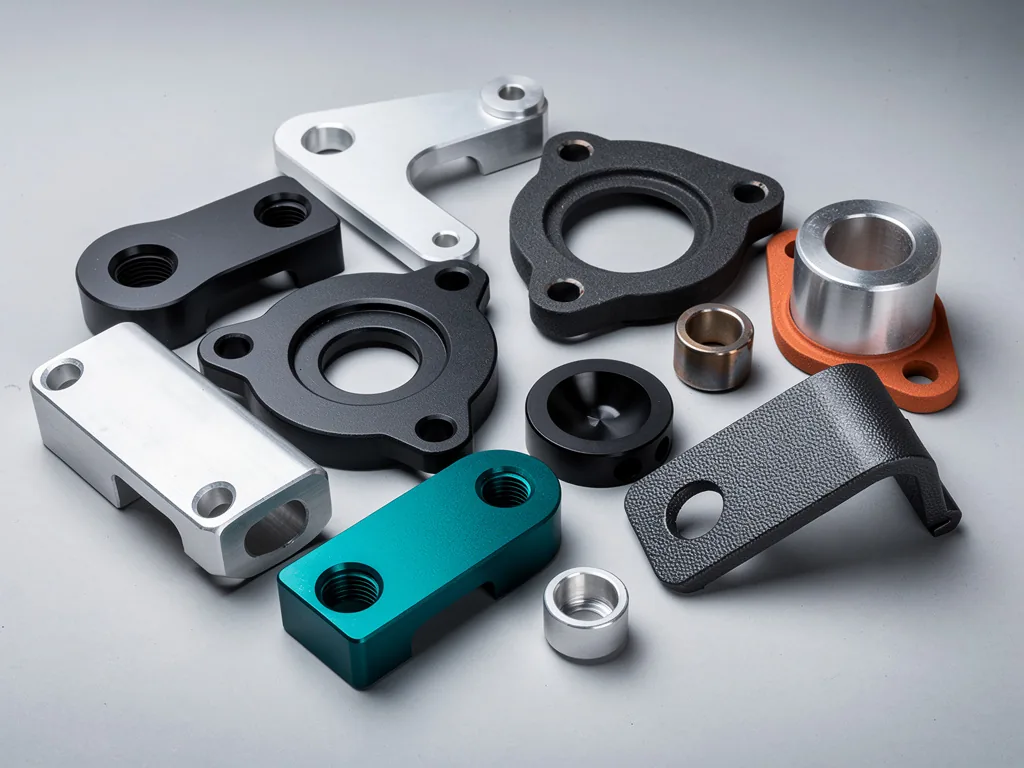
Surface finishing — sequenced into the same PO as the part.
Anodize (Type II / Type III), zinc and electroless nickel plating, hard chrome, powder coat, passivation, electropolishing, heat treatment, and laser marking — sourced through a network of qualified Mexican finishing shops. MIL-spec and ASTM compliance documented on every batch. You get a finished part, not a raw blank routed to a separate vendor.
Finishing belongs on the same PO as the part.
Most "finishing problems" are actually handoff problems — the machined part ships to a plater, who installed thread protection on the wrong holes, who sent it to a powder coater that fills the PEM threads, who delivers a part that's 0.0015" oversize on the bore. You should not have to project-manage three vendors to get a finished component. We do that. Send us the drawing with the finish callout (anodize per MIL-A-8625, plate per ASTM B633, etc.) and we route the full sequence through partners matched to the spec, then sign off on the certs before you do.
We check process compatibility (anodize-after-machining, masking on threads/bores), dimensional growth from the coating, and material/spec pairings — flagged before quoting.
Aerospace anodize (NADCAP) routes to a different shop than commercial powder coat. Heat treat for D2 die work routes to a different oven than stress-relief on aluminum.
Coating thickness verification, salt-spray reports when called for, RoHS / REACH declarations on chromate, and one Certificate of Conformance from GPW — not the partner shop.
Six finish families, one supplier.
Quick overview of the finish families we coordinate. Detailed specs in each section below.
Type II for color & corrosion. Type III for wear.
Anodizing converts the aluminum surface into a hard oxide layer through electrochemistry. The coating is integral to the metal — it does not chip, peel, or flake. Two types cover most applications.
Five plating processes. Each spec'd to a service class.
Plating deposits a metal layer on the substrate — for corrosion, wear, conductivity, or appearance. Service classes (SC1–SC4 in ASTM standards) define minimum thickness based on environment severity.
Electroless Nickel Plating
Uniform deposit on complex geometry — internal channels, blind holes, threads all coat at the same thickness. Service classes: SC1=5 µm, SC2=12.5 µm, SC3=25 µm, SC4=75 µm. As-plated 47–52 HRC; heat-treated to 65–70 HRC. Five phosphorus types: low-P (Type II/III) for hardness, mid-P (Type IV) general purpose, high-P (Type V) for corrosion. Salt spray >500 hr per ASTM B117 at SC3+.
Zinc Plating
Sacrificial corrosion protection for steel. SC1=5, SC2=8, SC3=12, SC4=25 µm. Type I clear, Type II yellow chromate, Type III colorless, Type IV phosphate. 96 hr salt spray min.
Hard Chrome
Wear-resistant hard surface. 20–127 µm typ. 66–72 HRC / 900–1200 HV. Hydraulic rods, rollers, tooling. Min 0.001" for full hardness on soft substrate.
Decorative Chrome
Cosmetic chrome over nickel base. 0.25–0.75 µm chrome over 10–25 µm nickel. Visible parts, consumer products.
Copper Plating
Pre-plate base layer for nickel/chrome stack-up. EMI / RFI shielding. Heat conductivity enhancement.
Powder, paint, and electrocoat.
Organic coatings provide color, UV stability, and chemical resistance without changing the substrate. Sequenced after plating or hardware install when both are required.
Powder Coating
Electrostatic dry powder, oven-cured at 350–400°F. Thickness 50–125 µm (2–5 mils). Full RAL, BS, NCS, Pantone. 5–10+ year outdoor durability with polyester or hybrid.
Wet Paint
Liquid spray (primer + topcoat). For exact Pantone match, multi-color graphics, small batches, or parts that cannot survive 350°F cure.
E-Coat / Electrocoat
Electrochemically deposited cathodic primer — uniform coverage on complex geometry. Used as base under powder for automotive and outdoor parts.
Chemical treatments — near-zero dimensional change.
Conversion coatings react with the metal surface to form a thin protective layer. They do not add measurable dimension, which makes them the right call when tolerances are tight.
Chromate / Alodine
For aluminum. 0.25–1 µm — essentially zero dim change. Type II = trivalent (RoHS-compliant default). Class 1A for max corrosion or Class 3 for electrical conductivity.
Passivation (Stainless)
Citric or nitric bath removes free iron. Essentially zero dim change. Citric preferred for 440C (avoids hydrogen embrittlement). Standard for medical, food, pharma, machined / laser-cut stainless.
Black Oxide
For ferrous metals. Class 1 (alkaline) for steel, Class 4 for stainless (96 hr salt spray). Decorative dark finish + mild corrosion — requires oil/wax sealant to be useful for protection.
Phosphate (Steel)
Zinc or manganese phosphate. Used as paint primer base or oil-retaining surface for low-friction sliding parts.
Hardening, case depth, and dimensional stability.
Heat treatment changes the metal's internal structure — not just the surface. Required for tooling, gears, shafts, hardened dies, and any part where wear resistance or dimensional stability matters.
Hardening + Tempering
Quench above critical temp, temper to relieve brittleness. 4140: 28–50 HRC working · 4340: ~46 HRC · D2: 58–60 HRC · 17-4PH H900: ~44 HRC.
Carburizing (Case Hardening)
Diffuses carbon into surface at >1500°F. Hard outer shell 58–62 HRC with tough core. Case depth 0.5–2.0 mm typ. Best for gears, shafts, pins on low-carbon steel (8620, 1018).
Nitriding
Nitrogen diffusion at 491–566°C — no quench, no distortion. Case 0.2–0.65 mm. 10–80 hr cycle. Best for finished precision parts where carburizing distortion is unacceptable.
Stress Relief
Sub-critical heat (~1000–1200°F) and slow cool. Removes machining stresses without changing hardness. Critical for thin-walled or asymmetric parts that warp over time.
Annealing
Heat above transformation, slow cool. Softens the material, relieves stress, improves machinability. Typically pre-machining or between heavy operations.
PH Aging (17-4 / 15-5)
Precipitation hardening for stainless. H900 = 44 HRC, H1025 = 38 HRC, H1150 = 32 HRC. Required after machining solution-annealed PH stainless.
From bead-blast matte to mirror polish.
Mechanical processes change the surface texture — for appearance, deburring, paint preparation, or to remove a precise amount of material.
Glass Bead Blast
Spherical beads peen the surface — no material removal. Ra 0.4–1.2 µm on aluminum. Standard pre-treatment before anodizing for uniform appearance. Hides tool marks.
Aluminum Oxide Grit
Angular grit cuts an anchor pattern. Ra 1.5–4.0 µm, profile 1.5–2.5 mil. Surface prep for powder coat or paint adhesion.
Vibratory / Tumbling
Parts tumble in abrasive media for batch deburring. Removes burrs and breaks sharp edges from CNC and laser cuts. Cost-effective at volume.
Brushing (#3 / #4 / #6)
Directional grain finish. #3 (coarse), #4 (architectural — most common), #6 (fine satin). Industrial / architectural aesthetic on stainless.
Polishing (#7 / #8 Mirror)
Progressive abrasive smoothing. #7 = bright satin. #8 = mirror reflective. For consumer-facing, optical, food-contact, or decorative surfaces.
Electropolishing
Electrochemical removal of stainless surface. Min 6.4 µm per side material removal. Achievable Ra 1 µin (0.025 µm) — mirror smooth. Passivates while polishing. Medical, semiconductor, pharma, fluid-contact.
Pick the right finish from the requirement.
Most "what finish do I use?" decisions resolve quickly once the requirement and material are stated. The matrix below covers ~80% of cases.
5 steps from RFQ to finished, certified part.
Submit RFQ
CAD or drawing with finish callout (e.g., "anodize per MIL-A-8625 Type II Class 2 black"), material, quantity, and any masking requirements.
DFM + Match
GPW reviews dimensional growth, masking, process compatibility, and routes to a partner shop matched to the spec (NADCAP if aerospace).
First Article
First article finished and inspected: coating thickness verified per spec, color match confirmed, tolerances re-checked post-finish.
Production Run
Production batch finished per approved first article. In-process thickness checks per ASTM standard. Salt spray sample if specified.
Cert + Ship
Per-batch certs issued (MIL/ASTM cited), packaged to protect finish, customs cleared, delivered to your U.S. dock under one CoC from GPW.
Industries that depend on documented finishing
Surface finishing — answered.
What is the difference between anodize Type II and Type III?
Type II (sulfuric anodize, MIL-A-8625) is decorative + corrosion protection: 2.5–25 µm thick, available in clear (Class 1) or dyed colors (Class 2). Type III (hard coat) is wear protection: 13–150 µm, denser oxide, surface hardness exceeding 60 HRC. Type III adds significantly more dimension to the part — typically 50 µm per side at default nominal thickness.
Does plating add to part dimensions?
Yes — every coating except chromate conversion and black oxide changes the dimension. Type II anodize adds ~5 µm per side, Type III hard coat adds ~25 µm per side, electroless nickel SC3 adds 25 µm per side, hard chrome adds 25–125 µm per side. Specify pre-finish dimensions on your drawing for tight features and we mask threads and bores per the spec.
Which finish should I use for outdoor or marine environments?
For aluminum: Type II anodize or powder coat (polyester for UV stability). For steel: zinc plate SC3 (12 µm) or SC4 (25 µm) with chromate, or powder coat. For stainless: passivation per AMS 2700 / ASTM A967. For maximum salt-spray resistance, electroless nickel rated SC3+ provides 500+ hours per ASTM B117.
Can chromate conversion coating still be specified with hex chrome?
MIL-DTL-5541 Type I uses hexavalent chromium and is restricted under RoHS / REACH for many commercial applications. Type II uses trivalent chromium and is the RoHS-compliant choice — same corrosion performance, no hex-chrome restrictions. We default to Type II unless your spec explicitly requires Type I (still permitted for some defense / aerospace work).
How does GPW coordinate finishing with machining?
Finishing is sequenced as part of the same project — same RFQ, same PO, same Certificate of Conformance. We schedule the finishing slot before the machining shop ships, account for masking on threaded features and tight bores in the DFM review, and inspect the finished part against your drawing — including thickness verification per spec where required.
Do you provide finish certifications?
Yes. Per-batch certs available for: anodize (MIL-A-8625), chromate (MIL-DTL-5541), zinc plating (ASTM B633), electroless nickel (ASTM B733 / AMS 2404), passivation (AMS 2700 / ASTM A967), electropolishing (ASTM B912), black oxide (MIL-DTL-13924), and powder coating (per RAL/Pantone match). Certs accompany the shipment when specified at quote.
Do you operate your own finishing lines, or do you use partner shops?
GPW operates a network of qualified finishing partner shops across Mexico — anodizing lines, plating tanks (zinc, nickel, chrome), powder coat booths, passivation, heat treat ovens, electropolishing, and laser marking. We handle engineering review, supplier selection, quality control, and logistics. You never coordinate with the partner shop directly. One quote, one PO, one Certificate of Conformance from GPW.
Send us your drawing with the finish callout.
Material, finish spec (MIL or ASTM), masking requirements, color, and thickness class. We respond within 24 business hours with pricing and a free DFM review — matched to the right finishing partner shop in our network.
Spec-cited certs · NADCAP partners for aerospace · sales@gpw-solutions.com