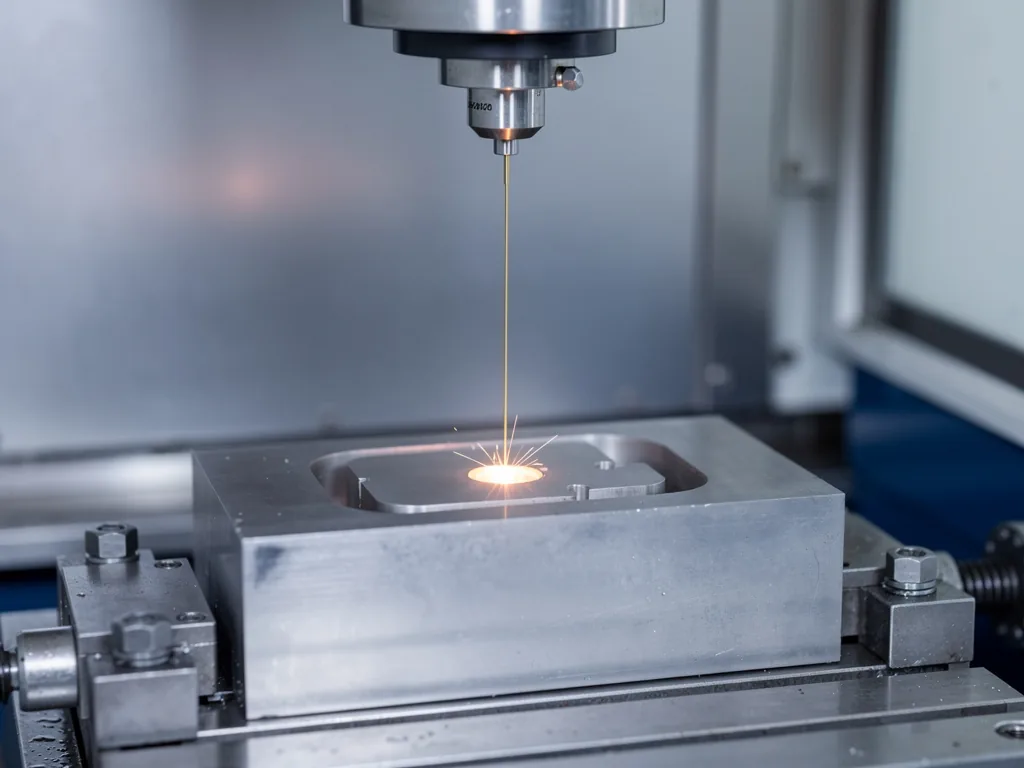
Wire EDM — for hardened steel, carbide, and the geometries milling cannot reach.
Sub-thousandth tolerances. Burr-free, heat-affected-zone-free cuts. Cuts hardened tool steel (60+ HRC) without softening it. Includes small-hole EDM for starter holes, multi-pass skim cuts for finish, and submerged cutting for thermal stability — coordinated across our network of qualified Mexican EDM partner shops.
The process that mills cannot replace.
Wire EDM is not just "cutting with electricity." It is the only process that produces tight inside corner radii in hardened tool steel, that cuts tungsten carbide without grinding, that handles complex 2.5D profiles in 4" of D2 without burrs or fixturing distortion. You do not have to know the difference between rough cut and skim pass — we handle the multi-pass strategy, the starter holes, and the finish. Send the file, we match it to the right partner shop, we sign off the inspection report before you do.
We check tolerance feasibility, multi-pass strategy, starter hole placement, and whether the geometry is a true Wire EDM candidate vs. better suited to milling.
Production die work runs on a different machine class than carbide micro-features. We route to the partner with the right Z-thickness and submerged-cut capability.
Dimensional inspection, recast layer measurement when called for, customs paperwork, and delivery to your U.S. dock — consolidated under one Certificate of Conformance from GPW.
Specs that procurement can paste straight into the BOM.
The envelope below covers what our partner network handles routinely — including small-hole EDM for starter holes, submerged cutting for finish, and multi-pass strategy for tight tolerances.
Seven categories where Wire EDM is the right call.
If your part involves hardened steel, carbide, tight inside corners, or geometries milling cannot reach — it falls into one of these.
Stamping Dies, Punches & Inserts
Blanking dies, forming dies, fineblanking dies, punch sets, mold details, extrusion tool inserts. Cut from D2, A2, M2, or CPM-10V in the hardened state — no soft-mill / heat-treat / grind cycle required.
Gear Forms & Splines
Fine-pitch gears, racks, spline profiles, sprocket teeth in hardened steel.
Aerospace Slots & Fir-Trees
Turbine blade fir-tree roots, disk slots, complex profiles in Inconel and titanium.
Medical Surgical Components
Bone screw thread profiles, implant features, surgical instrument cutouts in Ti-6Al-4V and stainless 316. Recast layer fully removed.
Inspection Masters & Gauge Blocks
Go / no-go gauges, inspection masters, calibration standards in hardened tool steel.
Prototype Hardened Components
Skip the soft-mill / harden / grind cycle — cut directly from hardened stock for one-off prototypes.
Carbide Tooling & Inserts
Tungsten carbide blanks, cutting tool inserts, wear pads. Wire EDM is one of the few processes that cuts carbide cleanly.
Conductive metals only — everything else needs a different process.
Wire EDM cuts most electrically conductive metals. Hardness is not a limitation — the harder, the better the case for EDM.
Where Wire EDM Excels
5 familiesAlso Cut (when geometry justifies)
5 familiesHow tolerance and finish improve with each skim pass.
Wire EDM is rarely a single-pass process. Tolerance and surface finish are achieved by following the rough cut with progressively finer skim passes.
5 steps from RFQ to delivery.
Submit RFQ
CAD or drawing with material, hardness (if hardened), tolerance callouts, and surface finish requirements.
DFM + Match
GPW engineering reviews within 24 hours. We define multi-pass strategy, starter hole locations, and route to the right partner shop.
First Article
Partner cuts the first piece (rough + skim passes). Dimensional report covers all toleranced features. GPW signs off before you do.
Production Run
Production parts cut per approved program. In-process verification on critical dimensions. Recast layer measurement when called for.
Inspect + Ship
Final inspection per drawing. Material certs, customs cleared, delivered to your U.S. dock under one CoC from GPW.
When to use Wire EDM. When to use milling.
Wire EDM and milling solve different problems. Here is the rule of thumb.
Industries that depend on Wire EDM
Wire EDM — answered.
What materials can Wire EDM cut?
Most electrically conductive metals — hardened tool steel (D2, A2, H13, S7, M2, M4, CPM grades), tungsten carbide, stainless steel including 440C and 17-4PH, titanium, Inconel, copper, and aluminum. Wire EDM cannot cut plastics, ceramics, composites, or any non-conductive material — for those, recommend laser cutting, water jet, or milling.
Why use Wire EDM instead of milling?
Wire EDM cuts hardened material (60+ HRC) without softening it, applies no mechanical force on the workpiece (no fixturing distortion), leaves no burrs, and has no heat-affected zone when properly skim-passed. It is the only process that delivers tight inside corner radii in hardened steel without secondary operations.
What tolerances can you hold?
Standard tolerance ±0.0005" (±0.013 mm). Precision tolerance ±0.0001" (±2.5 µm) achievable with multi-pass cuts (rough + 2–3 skim passes). Position accuracy of the EDM machines themselves is ±0.0001" (±2.5 µm).
What surface finish can you achieve?
As-cut (single rough pass): Ra 80–120 µin (2.0–3.0 µm). One skim: Ra 32 µin (0.8 µm). Three skims: Ra 16 µin (0.4 µm). Submerged cutting with multiple skims: Ra 8 µin (0.2 µm) or better.
Do you handle the starter holes?
Yes. Closed contours (cuts that do not start from an outside edge) require a starter hole drilled with a small-hole EDM. We include this in the same RFQ — 0.012" to 0.040" diameter, depth-to-diameter ratios up to 200:1.
How thick can you cut?
Up to 16" (400 mm) on standard machines, up to 20" (500 mm) on extended-Z partner shops. Wire EDM cycle time scales with perimeter and thickness — 4" of hardened steel runs at roughly 1.5–2 in²/hr.
Do you operate your own machines, or do you use partner shops?
GPW operates a network of qualified Wire EDM partner shops across Mexico — including small-hole EDM for starter holes and submerged cutting for precision work. We handle engineering review, supplier selection, quality control, and logistics. You never coordinate with the partner shop directly. One quote, one PO, one Certificate of Conformance from GPW.
Send us your drawing.
Material, hardness, tolerance, surface finish, and thickness. We respond within 24 business hours with pricing, multi-pass strategy, and a free DFM review — matched to the right Wire EDM partner shop in our network.
No minimum order · NDA available · sales@gpw-solutions.com
Need a different process?
CNC Milling →
For soft materials, 3D pockets, and prismatic parts — faster than EDM when geometry permits.
CNC Turning →
Cylindrical parts — shafts, pins, fittings. Conventional, Swiss, and live-tooling lathes.
Surface Finishing →
Heat treatment, plating, passivation, polishing — secondary operations coordinated through partners.