AI Server Rack Assembly — Engineered for the Pace of Hyperscale Deployment
Global Precision Works (GPW) delivers rack-level integration for AI server hardware — thermal management, high-density cable routing, power distribution, and burn-in testing — from a nearshore facility in Monterrey, Mexico, two hours from Texas.
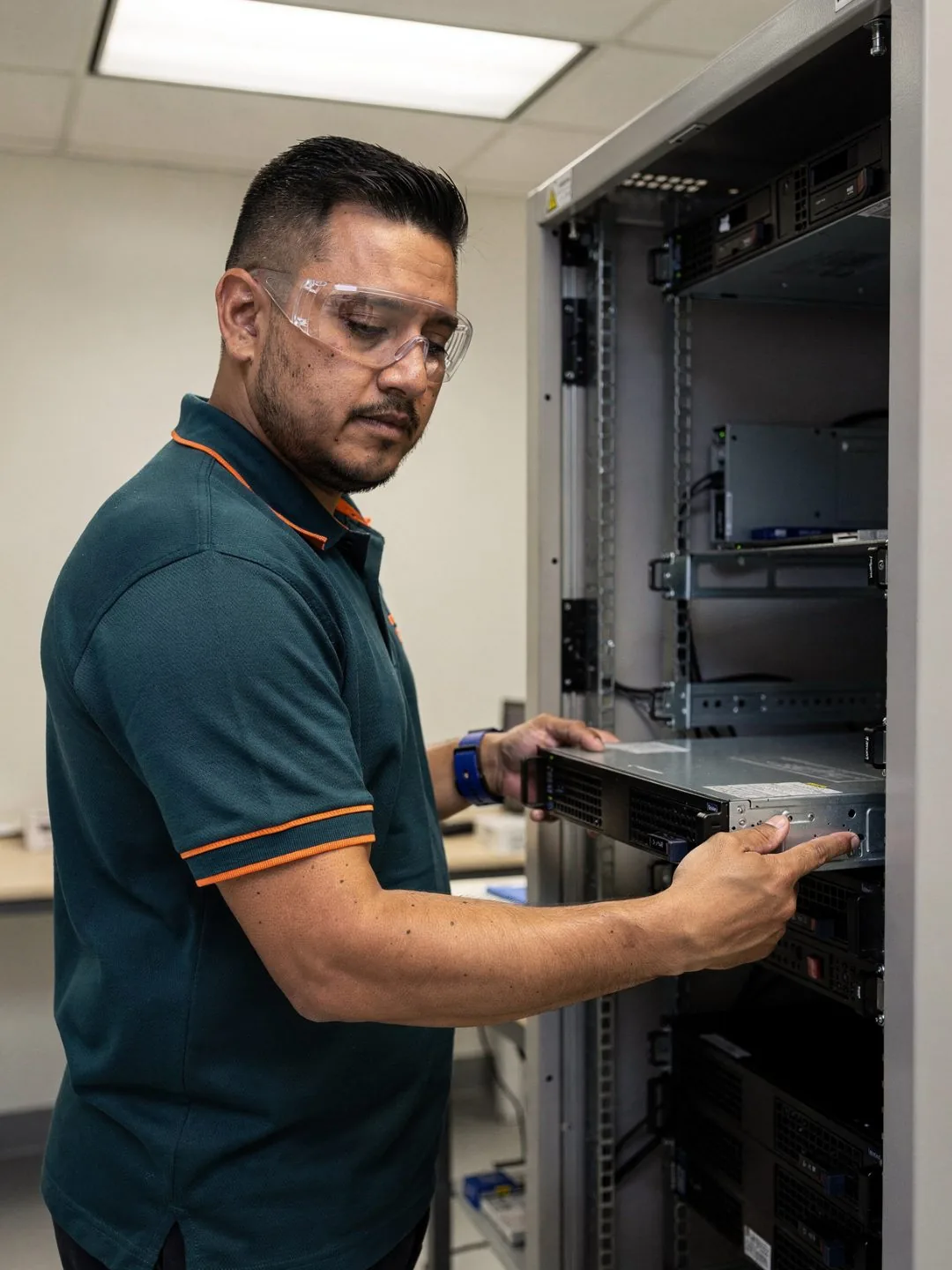
The race to deploy AI infrastructure is measured in weeks, not quarters. Hyperscaler and enterprise OEMs are scaling compute capacity faster than their supply chains can keep up. Assembly slots are full. Lead times from Asia stretch past acceptable windows. Domestic U.S. capacity is limited and expensive.
GPW exists at that intersection — where the demand for precision AI server assembly meets the need for speed, proximity, and cost discipline. Our Monterrey facility is purpose-configured for rack-level server integration: mechanical assembly, component mounting, dense cable routing, thermal system installation, firmware loading, and multi-point burn-in testing. One facility. One program manager. One timezone as your U.S. operations team.
This is not a repurposed PCBA line handling server builds on the side. GPW is an assembly-first operation — every workstation, every fixture, every quality gate is designed around building complete systems, not populating circuit boards.
What Is AI Server Rack Assembly?
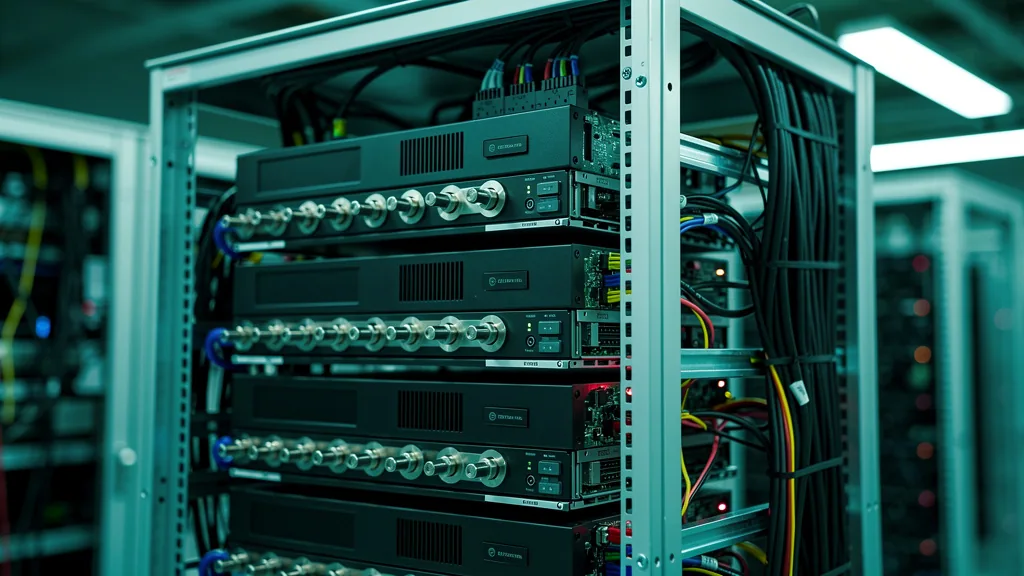
AI server rack assembly is the process of integrating mechanical structures, compute modules, networking hardware, power distribution systems, cooling infrastructure, and cabling into a fully functional server rack ready for data center deployment. Unlike PCBA fabrication — which produces individual circuit boards — rack assembly takes finished components and builds them into a complete, tested system: chassis mounted, nodes installed, cables routed, firmware loaded, and burn-in validated. For OEMs shipping AI infrastructure, rack assembly is the final and most complex stage of hardware production — where component quality meets integration precision.
The AI Hardware Boom Is Outpacing Traditional Assembly Models
Global spending on AI server infrastructure is accelerating at a pace that has reshaped manufacturing priorities across the electronics industry. Hyperscaler data center operators — along with enterprise customers building private AI clusters — are placing orders at volumes that exceed what legacy supply chains were designed to handle.
This surge is not just about more servers. The hardware itself is more complex. Modern AI server racks integrate high-wattage GPU modules, liquid cooling loops or advanced air cooling systems, high-density power distribution units, and thousands of cable connections per rack. Assembly tolerances are tighter. Thermal management is critical — a misrouted cooling line or improperly seated heat sink can take an entire rack offline. Testing requirements go beyond basic power-on: burn-in cycles, thermal stress validation, and firmware verification are standard before any rack ships to a data center.
Continue reading Show less
What this means for OEMs:
Traditional EMS providers built their operations around PCBA fabrication and surface mount technology. They added server assembly as a secondary capability — running rack builds through facilities optimized for board-level production. The result is predictable: scheduling conflicts, deprioritized assembly programs, and lead times that stretch when SMT lines take priority.
OEMs shipping AI hardware need an assembly partner whose primary capability is building complete systems — not a board house that also does some final assembly. They need a facility where server rack integration is the main event, not an afterthought.
The complexity gap is widening. Each new generation of AI accelerators increases power density, thermal load, and interconnect count. Racks that required 200 cable connections two years ago now require 400. Cooling systems that relied on standard fan trays now demand liquid distribution manifolds with leak-tested connections at every node. The assembly partner you choose needs to handle this complexity today — and scale with the next generation.
That is the gap GPW was built to fill. Assembly-first. Multi-rack capable. Configured for the thermal, mechanical, and electrical complexity that AI hardware demands — and designed to evolve as that complexity increases with each hardware generation.
What GPW Builds — Rack-Level Integration for AI and High-Performance Compute
GPW's AI server assembly capability covers the full scope of rack-level integration — from bare chassis to a fully tested, packaged rack ready to ship to your data center or distribution hub. Every step happens on one production floor, under one quality system, managed by one program team that works your hours in your timezone.
Mechanical Assembly and Chassis Integration
Every AI server rack starts with a mechanical structure — the chassis, rails, mounting brackets, and structural reinforcements that support the compute, networking, and power components. GPW assembles and validates the mechanical foundation before any electronics are installed: torque-verified fasteners, alignment checks on rail systems, and dimensional validation against customer specifications.
For multi-node server configurations, GPW manages the mechanical integration of individual compute trays, storage nodes, and networking modules into a unified rack structure. GPW verifies each node position for mechanical fit, airflow clearance, and serviceability access before the rack moves to electrical integration.
High-Density Cable Routing and Power Distribution
AI server racks are cable-intensive. A single rack can contain hundreds of individual cable assemblies — power cables, data cables, management network connections, and sensor wiring for thermal monitoring. Routing these cables through a dense rack without blocking airflow, creating electromagnetic interference, or impeding future serviceability requires disciplined cable management.
GPW's cable routing process follows documented routing maps specific to each rack configuration. GPW defines cable paths during the DFM review, validates them during first article builds, and executes them consistently in production. Every cable is routed, dressed, and secured according to the approved routing plan — with bend radius compliance, strain relief at termination points, and clear labeling for field serviceability.
Power distribution installation follows the same disciplined approach. GPW installs and validates power distribution units (PDUs), verifies wiring to each node position, and confirms voltage and polarity at every connection point before energizing the rack.
Thermal Management System Installation
Thermal management is not optional in AI hardware — it is a critical performance variable. Whether the rack uses traditional forced-air cooling, direct-to-chip liquid cooling, or a hybrid approach, GPW installs and validates the thermal system as an integrated part of the assembly process.
For air-cooled configurations, GPW installs fan assemblies, validates airflow paths, and confirms that cable routing does not obstruct intake or exhaust zones. For liquid-cooled systems, GPW installs manifolds, connects cooling lines to individual node cold plates, performs pressure testing to validate leak-free connections, and documents flow rates at each distribution point.
Thermal system validation happens before the rack enters burn-in testing. GPW does not treat cooling installation as a separate workstream — it is integrated into the assembly sequence so that thermal performance is validated in context, not in isolation.
Firmware Loading and Configuration
Once the rack is mechanically assembled, cabled, and thermally validated, GPW loads firmware and configuration files to each compute node, baseboard management controller (BMC), and networking component. GPW controls firmware versions through the customer's approved revision list and does not deviate from the specified configuration.
Configuration validation confirms that each node reports correctly to the rack management system, that network interfaces are active, and that storage devices are recognized. Any node that fails configuration validation is flagged, diagnosed, and corrected before the rack moves to functional testing.
Burn-In Testing and Functional Validation
AI server hardware must prove it can sustain full-load operation before it ships. GPW operates a dedicated burn-in and test area configured for rack-level validation:
- Power-on and POST validation: Every node confirmed operational at initial power-up
- Burn-in cycling: Extended operation under load conditions specified by the customer — typically 24 to 72 hours depending on the program
- Thermal stress monitoring: Temperature readings captured at defined intervals during burn-in to confirm cooling system performance under sustained load
- Functional testing: Customer-defined test scripts executed to validate compute, memory, storage, and networking performance
- Visual and cosmetic inspection: Final inspection for cable dress, label placement, cosmetic damage, and shipping readiness
Every rack that passes burn-in and functional testing receives a documented test report — linked to the rack's serial number and traceable to the specific test equipment, operator, and test protocol revision used.
Precision-Machined Components for AI and Server Rack Hardware — Coordinated, Documented, Delivered
Before a rack is assembled, the chassis, brackets, cold plates, and enclosures have to be machined to spec. GPW coordinates that precision machining for AI and server rack programs through a vetted network of Monterrey machine shops — GPW owns the DFM, quality governance, material sourcing, and delivery, so you sign one contract with one accountable partner. Machined parts feed straight into in-house assembly, which means scalable capacity without a single-shop bottleneck and no handoff gap between a part supplier and your build line.
Machining Processes for Rack Chassis, Cold Plates, and Enclosures
AI and server rack hardware leans on two machining disciplines: precision sheet metal for chassis, rack-mount enclosures, panels, and cable-management hardware; and milled work for structural brackets, busbar mounts, manifold blocks, and the cold plates that carry liquid cooling to high-wattage GPU nodes. The network handles laser cutting, CNC bending, and welding on the sheet-metal side, and 3- to 5-axis milling where flatness and feature tolerance drive thermal contact and rack fit.
Cold plates and heat-sink interfaces demand tight flatness and surface finish to seat against the die — so surface finishing closes out every job. GPW scopes each part to the right shop and process during the free DFM review, matches finishing to the application, and delivers components finished and inspected, ready to drop into the rack build — not raw stock that needs another vendor.
Materials the Network Machines for AI and Server Rack
Material choice drives thermal and structural performance in rack hardware. The network machines 6061 and 7075 aluminum for chassis, brackets, and lightweight enclosures; copper and high-conductivity copper alloys for cold plates, busbars, and heat sinks where thermal transfer matters most; and steel and stainless for load-bearing rack frames and hardware. GPW owns the material selection and DFM guidance behind every choice — not the customer chasing it across shops.
When a part calls for a different alloy or temper, GPW recommends the option that holds tolerance, manages weight, and meets thermal targets during the free DFM review — then sources certified stock with documentation that follows the part through machining and into assembly.
Quality, Documentation & Accountability
GPW owns quality governance across the network so the customer never inherits shop-to-shop variation. Every machined component is inspected to GPW's quality standard, with dimensional verification on critical features — cold-plate flatness, mounting-hole position, panel fit — and a documentation package that travels with the part: material certifications, inspection records, and lot traceability back to the source stock and the shop that ran it.
That traceability carries forward into the in-house build, so a finished rack traces from raw stock through machining to the tested unit on your dock. Every build follows documented workmanship and inspection standards with audit-ready documentation, and GPW accommodates customer-specific quality plans and audit protocols from day one.
GPW responds to every RFQ within 48 hours with an initial program assessment.
Get a Quote for Your AI Server Program Get a Quote for Your AI Server ProgramWhat a Typical AI Server Assembly Program Looks Like at GPW
Every AI server program is different — different OEMs, different rack architectures, different deployment timelines. But the programs share structural similarities that illustrate how GPW manages complexity at scale.
Multi-Node GPU Compute Rack
A U.S.-based OEM designs a 42U rack housing 8 high-density GPU compute nodes, 2 networking switches, redundant power supplies, and a liquid cooling distribution system. Each compute node contains 8 GPUs, 2 CPUs, 24 DIMMs, and multiple NVMe storage devices — all requiring precise mechanical mounting, thermal interface material application, and cable interconnection.
GPW receives the components — customer-furnished GPU modules, GPW-procured mechanical parts and cables — and executes the full assembly: node-level sub-assembly, rack-level integration, liquid cooling line installation and pressure testing, cable routing for power and data, firmware loading across all nodes, and a 48-hour burn-in cycle under full compute load. The finished rack ships palletized from Monterrey to the customer's data center staging facility in Texas — 2 days door-to-door.
Edge AI Inference Server
An enterprise OEM produces a compact 2U inference server designed for deployment at telecom edge locations. The server integrates 4 AI accelerator cards, a custom cooling shroud, high-speed networking, and a ruggedized enclosure rated for non-climate-controlled environments.
GPW manages the full box build: mechanical assembly of the enclosure and internal brackets, accelerator card installation with thermal pad application, cable routing within a compact footprint, firmware loading, and a functional test sequence that includes thermal cycling to simulate edge deployment conditions. Monthly volumes scale from 50 units during initial production to 500+ units within 6 months.
AI Training Cluster — Multi-Rack Integration
A hyperscaler customer requires a complete AI training pod consisting of 4 interconnected racks: 2 compute racks, 1 high-speed networking rack, and 1 power and cooling distribution rack. The pod must be integrated as a system — inter-rack cabling, shared cooling manifolds, and unified management firmware — and shipped as a tested, ready-to-deploy unit.
GPW assembles each rack individually, then performs system-level integration: inter-rack cable installation, shared cooling circuit connection and leak testing, cross-rack firmware configuration, and a full-pod burn-in that validates compute, networking, and thermal performance as a unified system. The 4-rack pod ships on a custom pallet system designed for data center dock receiving.
Why Monterrey for AI Server Assembly — Speed, Proximity, and Cost Discipline
AI hardware OEMs face a sourcing trilemma: domestic U.S. assembly is fast but expensive, Asian assembly is cheaper but slow and exposed to geopolitical risk, and existing nearshore options are mostly PCBA-focused facilities that treat server assembly as secondary. GPW's Monterrey operation resolves that trilemma.
Speed
GPW is two hours from Texas by road. Finished racks reach Texas distribution centers in 1-2 days by truck — no ocean freight, no customs brokerage delays across continents, no 6-8 week transit windows. When a hyperscaler accelerates a deployment timeline, GPW can respond in days, not months.
Proximity
Same timezone as Central and Eastern U.S. operations. Your program manager in Monterrey is available during your working hours for real-time coordination — design change approvals, production status updates, quality issue escalation. No overnight email chains. No 12-hour time zone gaps. Direct flights connect Monterrey to Austin, Dallas, Houston, Phoenix, and San Jose.
Cost Discipline
Labor costs in Monterrey are 40-60% lower than comparable U.S. assembly operations. That cost advantage compounds in labor-intensive programs like server rack assembly, where each rack requires hours of skilled manual integration. USMCA compliance means finished assemblies enter the U.S. with preferential tariff treatment — a meaningful advantage over Asian-origin hardware facing Section 301 tariffs of 7.5-25%.
Supply Chain Resilience
Nearshore assembly in Monterrey diversifies your supply chain away from single-region concentration in Asia. GPW can serve as a primary assembly partner or as a second-source operation alongside your existing Asian supplier — reducing risk without requiring a full-scale supply chain migration.
Talent Availability
Monterrey is Mexico's industrial capital — home to the country's largest concentration of manufacturing engineers and skilled technicians. The metropolitan area produces thousands of engineering graduates annually from institutions like Tecnológico de Monterrey and Universidad Autónoma de Nuevo León. GPW draws from this talent pool for assembly technicians, quality engineers, and program managers.
Regulatory Alignment
USMCA (the successor to NAFTA) provides a clear framework for nearshore manufacturing. Assemblies produced in Mexico with qualifying content receive preferential tariff treatment entering the United States. For AI hardware OEMs evaluating total landed cost, the combination of lower labor costs, preferential tariffs, and minimal transit time creates a cost structure that neither domestic U.S. assembly nor Asian offshore production can match.
For AI hardware OEMs under pressure to deploy faster while managing costs and supply chain risk, Monterrey is not a compromise. It is a strategic advantage.
Quality Systems Engineered for AI Hardware Precision
AI server hardware operates at the intersection of high performance and zero tolerance for error. A single assembly defect — an improperly seated connector, a cooling line with insufficient torque, a firmware mismatch — can take a rack offline and delay an entire deployment. GPW's quality system is designed to prevent those failures at every stage of the assembly process.
Process Control
Every assembly step follows documented work instructions displayed at the workstation. Operators execute each step in sequence, with sign-off required before the unit advances. There are no undocumented steps and no operator discretion on assembly sequence.
In-Process Quality Gates
GPW integrates inspection checkpoints throughout the assembly process — not just at the end. Mechanical assembly is verified before electrical integration begins. Cable routing is inspected before thermal systems are installed. Each gate catches issues at the point of origin, not after downstream work has been completed on top of a defect.
Traceability
Every component, every assembly step, and every test result is traceable to the individual rack by serial number. GPW's traceability system records lot numbers, date codes, operator identification, and test equipment calibration status for every unit produced.
Quality & Documentation
- Documented workmanship and inspection standards for electronic assemblies
- Documented workmanship and inspection standards for cable and wire harness assemblies
- Audit-ready documentation and documented work instructions
- Customer-specific quality requirements via program-level quality plans
ESD Control
All assembly and test areas operate under full ESD protection protocols — grounded workstations, personnel grounding, ESD-safe packaging, and humidity-controlled environments. AI server components — GPUs, memory modules, networking ASICs — are sensitive to electrostatic discharge at every stage of handling.
AI Server Rack
Assembly FAQ
A typical AI server program ramps through three stages: DFM review and process planning in 1-2 weeks, first article builds in 2-3 weeks, and production ramp within 4-6 weeks of first article approval. GPW can compress timelines by running parallel tracks when faster deployment is required.
Yes. GPW assembles both air-cooled and liquid-cooled configurations. For liquid cooling, GPW installs manifolds, connects cooling lines to cold plates, performs pressure testing at each connection point, and validates flow rates -- all integrated into the assembly sequence, not treated as a separate workstream.
Yes. GPW supports programs from 10-50 racks per month through 200+ racks per month. The facility and staffing model scales with program demand -- no minimum volume requirements force you into commitments that don't match your deployment schedule.
GPW uses a formal engineering change order (ECO) workflow. The engineering team assesses impact on assembly sequence, materials, fixtures, and test protocols. Approved changes are implemented with documented effectivity -- every rack after the change point follows the updated process, fully traceable in the production record.
GPW supports both models and hybrid configurations. Customer-furnished materials are received, inspected, kitted, and staged. GPW-procured components are sourced through the customer's approved vendor list or GPW's supplier network. Either way, full traceability is maintained from receiving dock to finished rack.
Every build follows documented workmanship and inspection standards, with first-article inspection, in-process checks, and full traceability. GPW also accommodates customer-specific quality requirements through program-level quality plans -- additional criteria or audit protocols are integrated from day one. We align to the quality requirements each customer program defines.
Racks ship by truck from Monterrey to U.S. destinations, typically reaching Texas distribution points within 1-2 days. GPW manages packaging to customer specifications, export documentation, and overland logistics coordination. USMCA-compliant documentation is provided for preferential tariff treatment.
Ready to Scale Your AI Server Assembly Program?
Whether you are launching a new AI hardware platform, scaling an existing program, or diversifying your assembly supply chain away from a single region — GPW is ready to build.
Our Monterrey facility is configured for rack-level AI server integration: mechanical assembly, cable routing, thermal system installation, firmware loading, and burn-in testing — under one roof, one quality system, and one program manager who works your hours.
The next step is a conversation. Send us your requirements and a program manager will respond within 48 hours with an initial assessment.
No commitment. No minimum order. Engineering-driven quoting.